KPHealth
A Gamified Health App for Kaiser Permanente
A preventative-health product concept that helps members build routines, understand risk, and connect with tailored health support.
Background
KPHealth is an app concept designed to help Kaiser Permanente members stay on top of their health routines, with a special focus on diabetes prevention and treatment.
Initial focus
- High risk of preventable disease:
- 34M people, or 10.5% of the US population, have diabetes.
- 90–95% have Type 2 diabetes.
- 88M have prediabetes, and most are uninformed.
- The US is becoming increasingly health-aware, especially among younger generations.
 KPHealth market context and initial focus
- High cost of healthcare:
- $327B in expenditure on diabetes treatment.
- 66% of the US population fears that they cannot afford healthcare.
Opportunity
- $430B market: A significant opportunity in the US diabetes market.
- $7B sector: The US health-coaching market presents strong growth potential.
- Digital advantage: Digital tools create an opportunity to stand out in a rapidly digitising healthcare landscape.
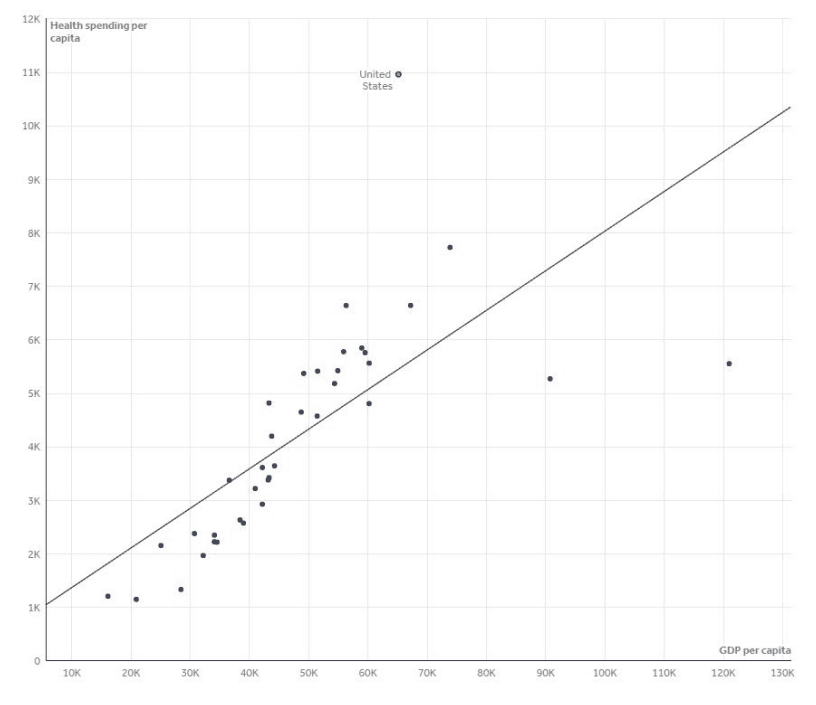 Average US healthcare expenditure per capita
Return on investment
Estimated first-year development costs:
| Area | Estimate |
|---|---|
| 2 Android and 2 iOS developers | $600K |
| Testing, support, sales, and project management | $700K |
| Marketing — PR, advertising, and SEO | $300K |
| Product management | $150K |
| Estimated revenue — 10% of members buying premium at $5/month | $60M |
 KPHealth return-on-investment model
Roadmap pillars
The app focuses on preventative care: forming habits, improving quality of life, lowering healthcare costs, and connecting users with experts for tailored support.
Strategic pillars:
- Personalised healthcare plans.
- Community building.
- Greater health awareness.
Expanding programmes
- Onboard more preventable diseases, including heart disease and PCOS.
- Improve the AI chatbot.
- Connect a 24/7 hotline.
- Partner with gyms, local supermarkets, and e-commerce companies.
Widening the scope
- Enhance core functionality.
- Use AI for chatbots and targeted health advice.
- Integrate smartwatches and pulse oximeters for more accurate results.
- Build a marketplace connecting doctors, dieticians, and coaches.
- Extend the product into mental wellbeing.
 Illustration accompanying the KPHealth roadmap
Product development
The project included a coordination map covering the cross-functional development work.
Marketing and pricing strategy
Acquisition channels
- App stores: Make the product accessible through both the Apple App Store and Google Play.
- Influencer marketing: Partner with health and wellness creators who have authentic audience relationships.
- SEO: Improve content and site structure to reach the target market.
- Email marketing: Reach KP members directly.
- Healthcare touchpoints: Place advertising in hospitals, diagnostic centres, and fitness facilities.
Revenue goal
The product aims to raise health awareness, encourage healthier lifestyles, and reduce the cost of diabetes treatment through preventative care. The pricing concept uses a $5-per-month freemium model; partnerships with gyms could provide an additional revenue path.
Preparing for launch
Pre-launch checklist
- Legal — review privacy issues.
- Marketing — prepare the blog post, release notes, and screenshots.
- Engineering — complete testing and launch readiness.
- Leadership — communicate the launch plan.
- Metrics — define downloads, stability, usage, and retention.
- App stores — submit the product for review.
Risks
- Security breach: Keep data security in place and give it high priority.
- No post-launch plan: Observe behaviour and maintain a clear improvement plan after release.
- Technical issues: Test repeatedly and include a post-launch response plan.